Cardiff (Wales), United Kingdom, 2017
– COMPIT’17 –
Hull Girder Cross Section Structural Design using Ultimate Limit States (ULS) Based Multi-Objective Optimization
Ming Ma, Justin Freimuth, Bruce Hays, DRS Technologies, Stevensville/USA
Nick Danese, Nick Danese Applied Research, Antibes/France, ndar@ndar.com
Abstract
The paper presents a method to optimize hull girder cross section scantlings based on stiffened panel ultimate limit states. A single frame spacing of the hull girder is modeled using plate and beam elements. A set of stiffened panels is then automatically defined based on the strong supports of the structure. The finite element model is loaded with multiple load cases, including end moments, external hydrostatic pressure, and internal tank pressure. The working stresses of a stiffened panel, which are used for the panel’s ultimate limit states assessment, are obtained by 3D finite element analysis. Each stiffened panel is then optimized using multi-objective genetic algorithms for its weight and safety. An iterative procedure is used to ensure the convergence of the working stresses. The hull girder ultimate strength is then obtained by nonlinear progressive hull girder strength analyses, such as ALPS/HULL. The result shows that the hull girder ultimate strength can be indirectly improved by optimizing local panel scantlings. An example of optimizing a cross section of a 200,000 ton oil tanker is presented. The numerical results show that the proposed method is very useful to perform ultimate strength based ship structural optimization with multi-objectives, namely minimization of the structural weight and cost and maximization of structural safety.
1. Introduction
As the demand for modern ships grows to meet greater reliability, efficiency, and economy, the interest in optimal ship structural design has also increased. At a ship conceptual design stage, once the general characteristics, principal dimensions and coefficients of form of a ship design have been established, midship structural design becomes a logical succeeding consideration. Standard practice dictates that design of a midship section be worked out as a basic and initial structural problem. Once this midship section has been specified, the major part of the hull design will follow logically from the pattern thus established. Since the bending moments and shear loads are greatest between the quarter points of the hull, the scantlings toward each end of the ship need only be given as modifications to the midship section. In ships of usual form, the midship section design is controlling enough to be commonly used in making estimates of hull weight and for purposes of bidding.
The optimization of a midship structural section involves a large number of variables such as (continuous) plate thickness, scantlings of stiffeners, and the (discrete) number of stiffeners. Further complication arises when the plates and stiffeners are constrained by yielding and buckling under various load conditions and subject to practical design rules. Although ship cross section design can be rather complicated, the attempts of structural scantling optimization have been plentiful and various strategies have been proposed. In terms of the optimization methods, there are basically two main types of optimization algorithms: the mathematical approaches (deterministic or gradient) and the heuristic or stochastic approaches including concepts inspired by natural biological systems. The main difficulties related to the use of gradient methods are that they can be trapped at points of local optimum and that the discrete variables have to be approximated as continuous variables. Because the objective functions and constraints are often highly nonlinear, the problems are usually either sequentially linearized and solved with linear programming, Hughes et al. (1980), or separated into a series of convex problems and solved accordingly with the non-linear gradient based method, Rigo and Fleury (2001). In contrast, heuristic methods offer the possibility of handling discrete variables as well as of providing global optimization capabilities. The heuristic methods have been growing in popularity over the last few years as more and more researchers discover the benefits of its adaptive search. Genetic Algorithm (GA) is one of the popular heuristic methods. Many papers now exist describing a multitude of different types of genetic algorithm, theoretical and practical analyses of GAs and huge numbers of applications, Coello (1999), Konak et al. (2006).
The genetic algorithm is an optimization technique that simulates the phenomenon of evolution in nature. The process of the GA starts by preferring chromosomes with high fitness. The chromosomes evolve through successive iterations, called generations. During each generation the chromosomes are evaluated, using some measure of fitness. To create the next generation, new chromosomes, called offspring, are formulated by using some operators called crossover and mutation. Thus, a new generation will be created by selecting the best chromosomes (parents) from the previous generation and the best chromosomes from the offspring. With single objective problems the genetic algorithm stores a single fitness value for every solution in the current population of solutions. This value denotes how well its corresponding solution satisfies the objective of the problem. By allocating the fitter members of the population a higher chance of producing more offspring than the less fit members, the GA can create the next generation of (usually better) solutions. For multiple objective problems, it is common practice to use a weighted sum to combine multiple objectives into a single objective. For example:
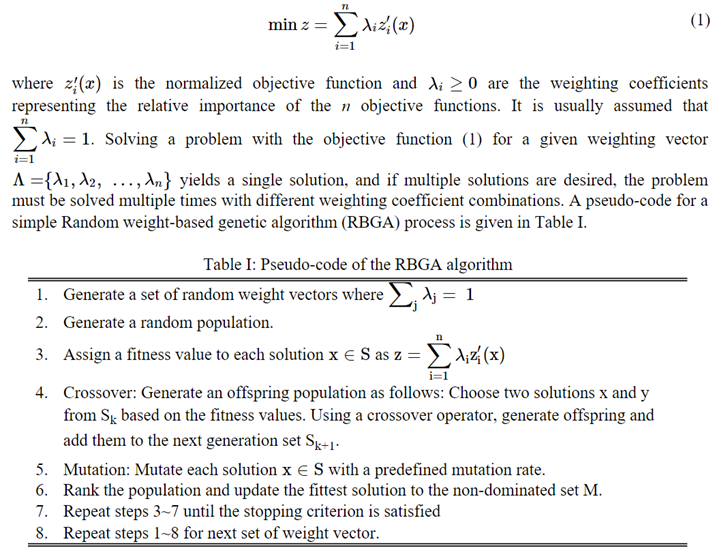
The main strengths of this method are its simplicity, efficiency, and suitability to generate a strongly non-dominated solution that can be used as an initial solution for other techniques. Its main weakness is the difficulty to determine the appropriate weights that can appropriately scale the objectives.
2. Limit state based structural optimization
In the field of ship structural optimization, a majority of applications use simple empirical constraints, such as scantling rules and stress limits specified by class societies, to size the structural scantlings. Today, it is well known that limit state is a better basis for the design and assessment of large thin-wall structures than allowable working stress. There are two ways to evaluate the limit states of a stiffened panel. One is to use full-blown nonlinear finite element analysis methods, and the other is to use semi-analytical approximate methods. Although general finite element tools are widely available and provide reliable results for structure instability analysis, their application can be prohibitive due to the computational time. This justifies the interest for more time-effective strategies, for which the main idea is to replace the finite element method with approximation techniques. The use of an analytical or semi-analytical approach results in an attractive strategy due to its effectiveness in terms of computational time, especially if compared with conventional numerical procedures such as the finite element method. This aspect becomes even more important when dealing with highly nonlinear analyses and in the context of optimization procedures, in which repeated analyses are required. Several closed-form solutions and semi-analytical approaches can be found in the literature for predicting the limit state of stiffened panels, Paik and Seo (2009). Among them, the ALPS/ULSAP method accounts for a wide range of loads and initial conditions, including combined in-plane longitudinal, transvers and shear loads, lateral pressure, initial deflection of plate and stiffeners, residual stress, structural dents, plate openings, impact pressure, corrosion, etc. The primary modes of overall failure for a stiffened panel or a grillage under predominately compressive loads can be categorized into the following six types, Paik and Thayamballi (2003), Hughes and Paik (2010):
- Mode I: overall collapse after overall buckling
- Mode II: collapse of the plating between stiffeners without the failure of stiffeners
- Mode III: beam-column type collapse of a stiffener with attached plating
- Mode IV: local buckling of stiffener web (after buckling collapse of attached plating)
- Mode V: lateral-torsional buckling (tripping) of a stiffener
- Mode VI: gross yielding
To effectively assess limit states of a stiffened panel, the structural response and working stress have to be known. Today, one of the most reliable methods to obtain structural response and stress is through finite element analyses. However, due to the nature of the repeated calculation in optimization, few approaches have attempted to directly integrate the finite element methods into optimization schemes. LBR5 uses an analytical method (based on differential equations of stiffened plates) to compute the overall response of the hull structure, Rigo (2005). This method is a direct analysis of the stress and strain of the prismatic part of the ship or a cargo hold. OCTOPUS, Zanic et al. (2009) uses customized super-element finite element method to compute the structural response of 2.5D segment.
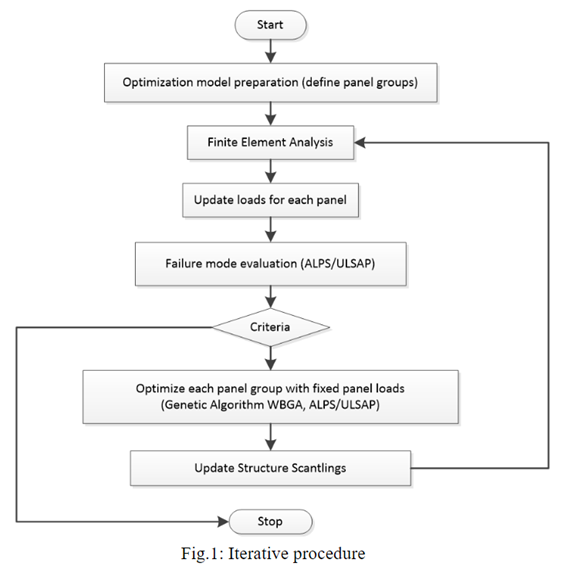
To leverage widely available generic finite element models, Ma et al. (2013) proposed a two-step heuristic based approach to optimize ship structures. The structural response is calculated using standard finite element models without any special modification. In the first step, the multi-objective optimization is performed at single stiffened panel level, assuming the applied load is constant. The semi-analytical ultimate limit state criteria, ALPS/ULSAP, are used to assess the panel’s safety. Once a collection of stiffened panels are optimized, a complete finite element analysis is performed to obtain the structural response of the optimized structure. The applied loads of stiffened panels are then updated. The optimization becomes an iterative process with a limited number of FEM response calculations. The overall iterative process employed is shown in Fig.1.
3. Objective functions and constraints
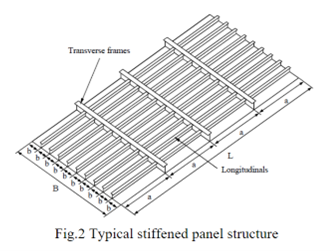
As indicated in the previous section, the multi-objective optimization is executed at the stiffened panel level. A typical stiffened panel is shown in Fig.2.
There are three objective functions for the problem. The first is the panel structural weight W:

where ρp, ρsx, and ρsy are the plate density, longitudinal stiffener density, and transverse frame density respectively. B and L are the panel width and length. tp is the plate thickness. Nx and Ny are the number of the longitudinal stiffeners and transverse frames respectively. bf, tf, hw and tw are the stiffener (or frame) flange width, flange thickness, web height and web thickness of the longitudinal stiffener or transverse frame.
The second objective function is the fabrication cost C, which is mainly welding. For a grillage the cost is

where cf is the welding cost per length of stiffener.
The third objective function is the safety measure for the panel or grillage η:

where Cd and Dd are the characteristic values of capacity and demand.
The optimization problem is to determine the optimum values of the variables (tp, bfx, tfx, hwx, twx, Nx, bfy, tfy, hwy, twy, Ny) which minimize the weight and cost while having a maximum safety measure. Without loss of generality, the multi-objective optimization assumes the form:

For genetic algorithm approach, the goal is to maximize the fitness on the design space of all possible configurations. The aggregated fitness function f can be expressed as

where W0 and
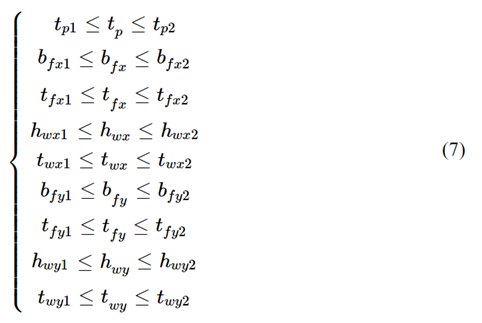
Upper and lower bound of the plate and stiffener scantlings can be prescribed by the users based on their design experience, technological preferences and the structure local safety requirements,
The number of the stiffeners can be limited as
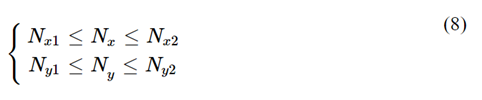
Manufacturing related constraints are:
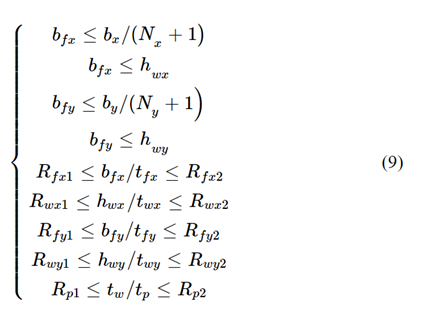
4. Application to midship structural design
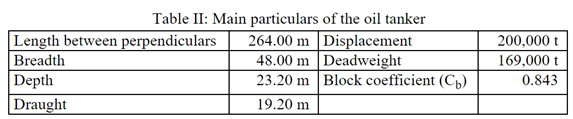
To illustrate the procedure of the optimization, a midship cross section of a 200,000 t double-hull oil tanker, Fig.3(a), Table II, is given in this section. The finite element model of the tanker has 121,368 nodes and 513,076 elements. The model is a generic Nastran finite element model. No special modeling modification is needed. The tanker has 6 cargo tanks and 6 ballast tanks, Fig.3(c) and 3(d). For the full load case, all cargo tanks are loaded with a total deadweight of 169,000 t. For the ballast load case, all ballast tanks are loaded with a weight of 52,000 t.

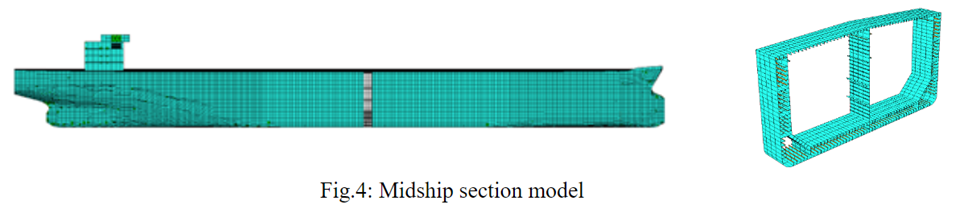
To optimize the structural scantling of the midship section, a segment between 2 frames is extracted from the full ship model using MAESTRO’s group feature. The extracted finite element model, Fig.4, has four elements lengthwise. In total, there are 5090 elements and 1477 nodes.
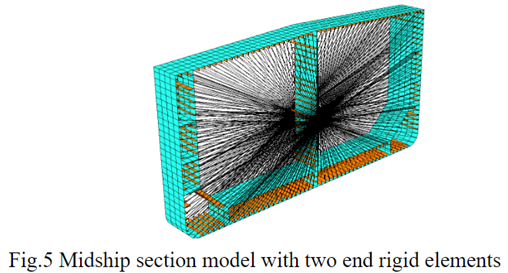
Using Eqs.(10) and (11), the vertical sagging moment and hogging moment are 1.11·10^6 m*t and 1.152·10^6 m*t, respectively. To apply the vertical bending moments to the model, two rigid elements (RBE2) are automatically added to the ends, Fig.5.
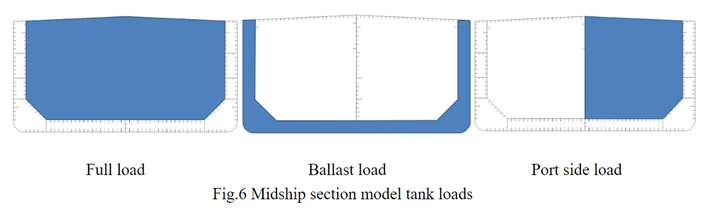
The midship section model is loaded with 3 load cases; full load, ballast load and port side load, as shown in Fig.6. In addition to the tank loads, the full load case has a sagging end moment of 1.111·106 m*t, and a hydrostatic load with 19.2 m draft; the ballast load case has a hogging end moment of 1.152·10^6 m*t, and a hydrostatic load with 7.26 m draft.
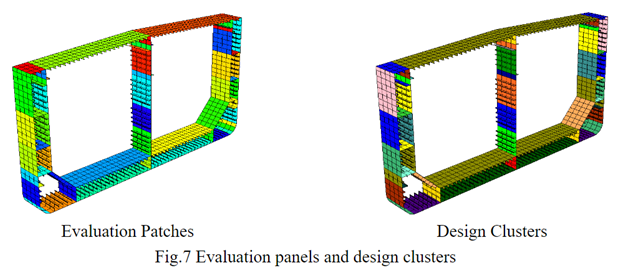
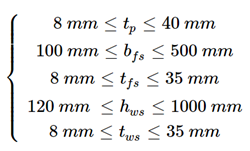
The safety factors for buckling and yielding are 1.5 and 1.25, respectively. The values of upper and lower bound constraints are given as
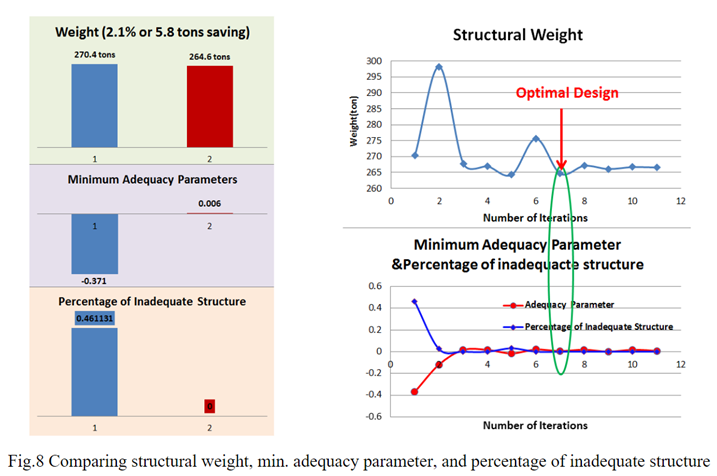
This example is an especially severe test of the optimization method presented in Section 2. This ship was originally designed using high-tensile steel in some regions. The owners subsequently decided to use only mild steel. In this optimization, the initial scantlings are those for the mild steel design, and consequently they are very inadequate. As shown in Fig.8, a full 46% of the structure was severely inadequate, with adequacy parameters as low as 0.371. In spite of this relatively weak initial design, the optimization converged in 7 design cycles. Because of the many inadequacies the optimization had to increase many of the scantlings, but it managed to find enough cases of overdesign to achieve a 2.1% weight savings (from 270.4 t to 264.6 t). The minimum adequacy parameter was improved from -0.371 to 0.006. The percentage of failed structure was reduced from 46% to 0%. Fig.8 shows the design history for structural weight, minimum adequacy parameter and percentage of inadequate structure for 7 design cycles. The optimization stops when there is no weight improvement in the next 5 cycles.
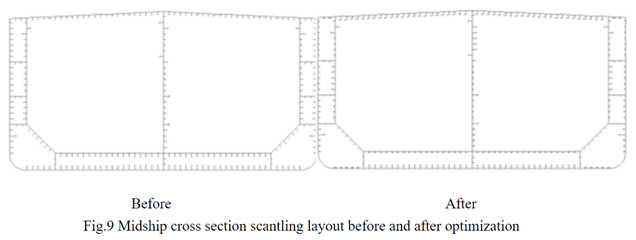
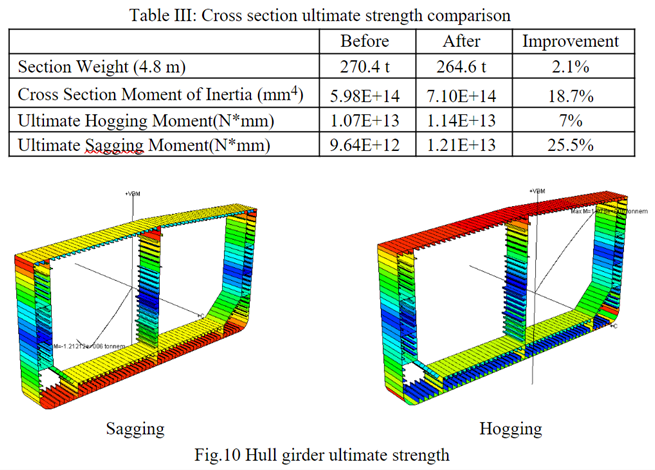
The cross section layouts before and after the optimization are illustrated in Fig.9. A comparison of the hull girder properties, such as cross section moment of inertia and hull girder ultimate strength, is listed in Table III.
The hull girder ultimate strength is calculated by progressive hull collapse analysis using ALPS/HULL (MAESTRO version 11, 2014) in sagging and hogging conditions. ALPS/HULL is a computer program for the special purpose of the progressive hull girder collapse analysis using the intelligent super-size finite element method. The program is fully integrated into the MAESTRO toolset. The accuracy of the ALPS/HULL computations in progressive hull girder collapse analysis has been demonstrated in Paik et al. (2008), by a comparison with nonlinear finite element method analyses. The cross sectional moment of inertia and hull girder ultimate strength are not the objectives of the optimization. The objectives of the optimization are the structural weight and the stiffened panel local ultimate strength. The example shows that optimizing panel local strength can also improve the global hull girder ultimate strength.
5. Conclusions
A random based genetic algorithm (RBGA) has successfully been used to optimize the midship section structural design of a 200,000 t tanker. To accurately determine the midship cross section load capacity at each design cycle, standard finite element analysis method is used. The objectives of the optimization are the structural weight and the ultimate local panel strength. The paper demonstrated that the hull girder ultimate strength can be significantly improved by optimizing panel local strength. Based on the examples, the proposed approach is capable of generating better midship section designs within reasonable search times. Given their flexibility and ease of implementation, the proposed multi-objective methods can be viewed as a valuable and attractive tool for structural optimization.
References
COELLO, C.A. (1999), An updated survey of evolutionary multiobjective optimization techniques: state of the art and future trends, Int. Conf. Evolutionary Computation (ICEC’99)
HUGHES, O.F.; MISTREE, F.; ZANIC, V. (1980), A practical method for the rational design of ship structures, J. Ship Research 24/2, pp.101-113
HUGHES, O.F.; PAIK, J.K. (2010), Ship structural analysis and design, SNAME
KONAK, A.; COIT, D.W.; SMITH, A.E. (2006), Multi-objective optimization using genetic algorithms: A tutorial, Reliability Engineering and System Safety 91, pp.992–1007
HUGHES, O.F.; PAIK, J.K. (2010), Ship structural analysis and design, SNAME
IACS (2012), Common structural rules for double hull oil tankers, Int. Assoc. Classification Societies, London
MA, M.; HUGHES, O.; PAIK, J.K. (2013), Ultimate strength based stiffened panel design using multi-objective optimization methods and its application to ship structures, PRADS2013, Changwon City
PAIK, J.K.; THAYAMBALLI, A.K. (2003), Ultimate limit state design of steel-plated structure, John Wiley & Sons
PAIK, J.K.; KIM, B.J.; SEO, J.K. (2008), Methods for ultimate limit state assessment of ships and ship shaped offshore structures – Part III: Hull girders, Ocean Engineering 35, pp.281-286
PAIK, J.K.; SEO, J.K. (2009), Nonlinear finite element method models for ultimate strength analysis of steel stiffened-plate structures under combined biaxial compression and lateral pressure actions – Part II: Stiffened panels, Thin-Walled Structures 47, pp. 998-1007
PAIK, J.K.; KIM, S.J.; KIM, D.H.; KIM, D.C.; FRIEZE, P.A.; ABBATTISTA, M.; VALLASCAS, M.; HUGHES, O.F. (2011), Benchmark study on use of ALPS/ULSAP method to determine plate and stiffened panel ultimate strength, MARSTRUCT2011, Hamburg, pp.169-186
RIGO, P. (2005), Differential equations of stiffened panels of ship structures and Fourier Series expansions, Ship Technology Research, pp.82–100
RIGO, P.; FLEURY, C. (2001), Scantlings optimization based on convex linearization and a dual approach – Part II, Marine Structures 14, pp.631-649
ZANIC, V.; ANDRIC, J.; PREBEG, P.; STIPCEVIC, M.; GRGIC, M.; KITAROVIĆ, S.; HADZIC, N.; PIRIC, K.; CHIRICA, I.; GIUGLEA, S.; GIUGLEA, V.; TURAN, O.; KHALID, H.; RIGO, P. (2009), RoPaX – Structural design aspects, IMPROVE 2009, Dubrovnik